



The Pension Research Council of The Wharton School of the University of Pennsylvania is committed to generating debate on key policy issues affecting pensions and other employee benefits. We sponsor interdisciplinary research on the entire range of private pension and social security programs, as well as related benefit plans in the United States and around the world.


Available Now:
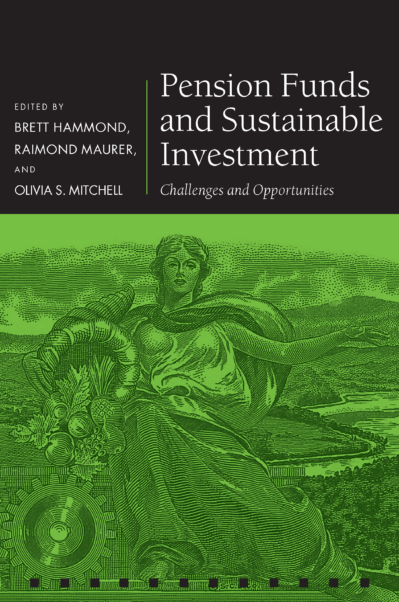
Pension Funds and Sustainable Investment: Challenges and Opportunities
P. Brett Hammond, Raimond Maurer, and Olivia S. Mitchell, Editors
Spring 2023
Pension Funds and Sustainable Investment: Challenges and Opportunities responds to rising global interest in environmental, social, governance (ESG), and impact investing to generate positive impact while generating financial return. Contributors explore the pros and cons of pension ESG investments and discuss case studies from the US and around the world. The findings will interest researchers, management/advisory firms, financial advisors, asset owners, and policymakers.
Sign up for the PRC Newsletter

Pension Research Council
The Wharton School of the University of Pennsylvania
3620 Locust Walk, 3302 Steinberg Hall–Dietrich Hall
Philadelphia, PA 19104-6302
Tel: 215.898.0424 | Fax: 215.573.3418 | prc@wharton.upenn.edu
Privacy Policy